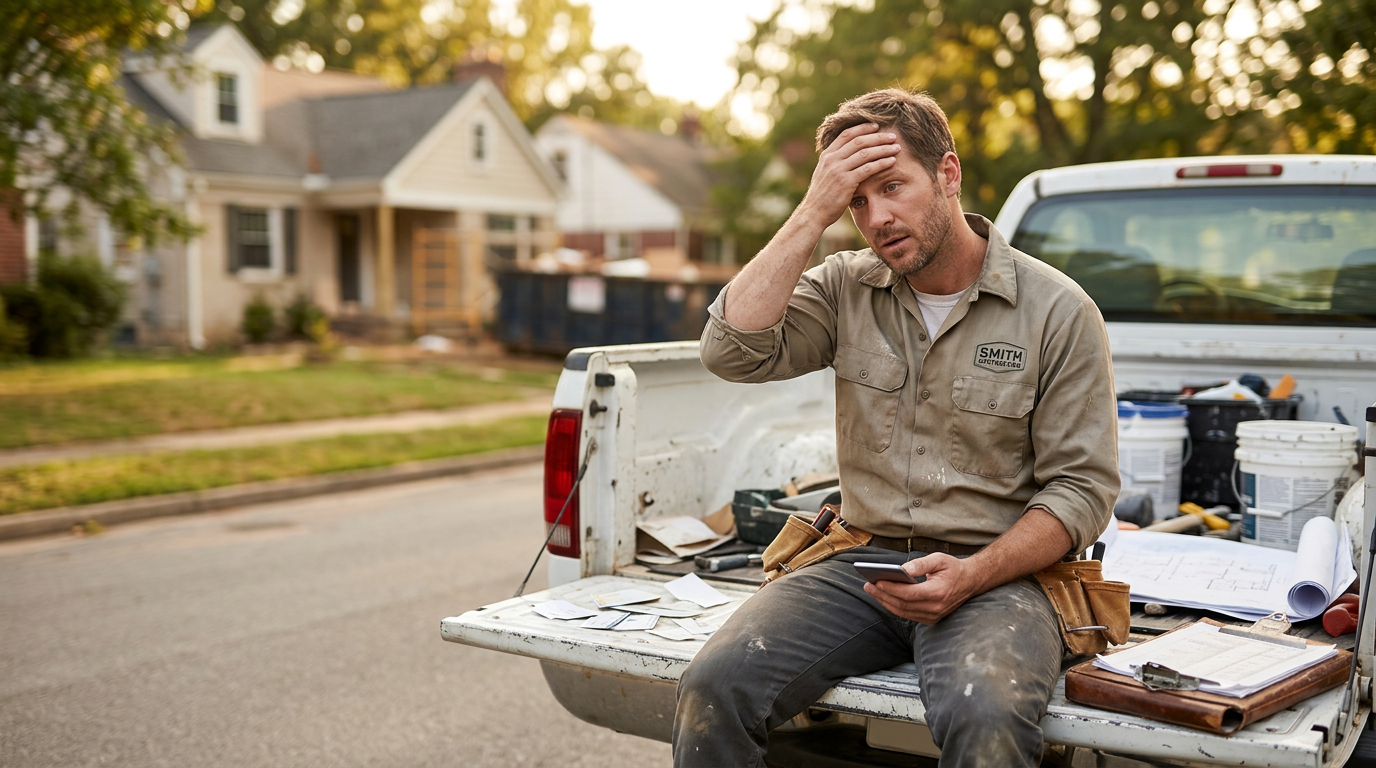
You’re halfway through a kitchen remodel, covered in drywall dust, when your phone buzzes in your pocket. New lead. Someone wants a quote on a bathroom renovation. You make a mental note to call them back after you finish hanging these cabinets. Two hours later, you pull out your phone, dial the number, and get voicemail. They already hired someone else. The contractor who picked up first got the job. That’s what poor lead follow up costs a contractor every single week.
This isn’t a hypothetical. It’s Tuesday. It’s Thursday. It’s every day you’re on a job site doing the work you’re good at while your phone collects missed opportunities.
The frustrating part? You didn’t lose that lead because your work isn’t good enough or your price was too high. You lost it because someone else answered faster. And the data on just how fast “faster” needs to be might surprise you.
Homeowners Hire the First Contractor Who Responds
Most homeowners hire the first contractor who responds to their inquiry. Not the cheapest. Not the one with the best reviews. The first one who picks up the phone or sends a reply. Industry data consistently backs this up, and if you’ve been in the trades long enough, you’ve seen it yourself.
Think about what that means for your business. If you’re the second contractor to call back, you’re already fighting an uphill battle for the leftovers.
And “first” doesn’t mean within the hour. It means within minutes. Research from Velocify shows that responding to a new lead within one minute dramatically increases conversion rates compared to slower responses. The old five-minute rule has become a one-minute rule.
Harvard Business Review research, cited by Traderise Advisors (2024), shows that companies responding within five minutes are significantly more likely to qualify a lead than those that wait just ten minutes. After 30 minutes, your odds drop sharply.
The window isn’t closing slowly. It’s slamming shut. And if you’re on a ladder or under a house when that lead comes in, you’re not getting to it in one minute. You’re probably not getting to it in thirty.
Every Missed Lead Costs You $90 or More
Here’s where it gets expensive. According to CallRail’s 2024 Home Services Marketing Statistics, construction and contractor leads average about $93.69 each. HVAC leads are right behind them. If you’re running Google Ads, paying for a lead service, or investing in SEO, every inquiry that hits your phone already has a price tag on it.
When that lead goes unanswered or gets a callback two hours later, you didn’t just miss a potential job. You burned the marketing dollars that generated it. The ad spend, the listing fees, the time you put into your online presence. All of it, gone, because nobody picked up.
As Modernize Home Services (2025) puts it, many contractors pour money into marketing only to let those leads go cold due to slow response times. You’re paying to fill a bucket that has a hole in the bottom.
And as Contractor Marketing Pros (2024) notes, lead costs are climbing across home services as competition and digital ad costs increase. The leads you’re generating today are more expensive than the ones you generated last year. Letting them slip through because you were busy on a job isn’t just wasteful. It’s getting more wasteful every quarter.
If you want to see how this math plays out across different types of small businesses, we broke down what a missed call actually costs your small business in detail.
Why Being Busy On-Site Is Killing Your Lead Follow Up as a Contractor
You’re not ignoring leads on purpose. You’re doing the thing your customers are paying you to do. You’re installing a water heater. You’re running electrical. You’re on a roof in July. You can’t stop mid-job to have a ten-minute phone conversation with a stranger about their deck project.
But the homeowner on the other end of that call doesn’t know you’re busy. They don’t know you’re good at what you do. They don’t know you’d be the best contractor for their project. All they know is that you didn’t answer and the next person on their list did.
Predictive Sales AI (2025) points out that many home services teams still rely on voicemail, delayed callbacks, or manual follow-up. If your team is busy in the field or wrapping up installs, those leads often go untouched until the end of the day. By then, the homeowner has moved on.
John Wilson of The Wilson Companies, quoted by Modernize (2025), makes an important distinction: most contractors think they have a “lead problem” when they really have a “conversion problem.” Their processes can’t handle the customer who wants to buy right now while the owner or tech is on a job. You don’t need more leads. You need to actually convert the ones you’re already paying for.
Bridgital (2024) echoes this, identifying the usual suspects behind poor conversion as slow responses, weak follow-up, and disconnected systems. Not a lack of leads.
That’s a critical shift in thinking. If you’re spending more on marketing because you feel like you’re not getting enough work, take a hard look at how many leads you’re actually responding to within five minutes. The answer might change your entire strategy.
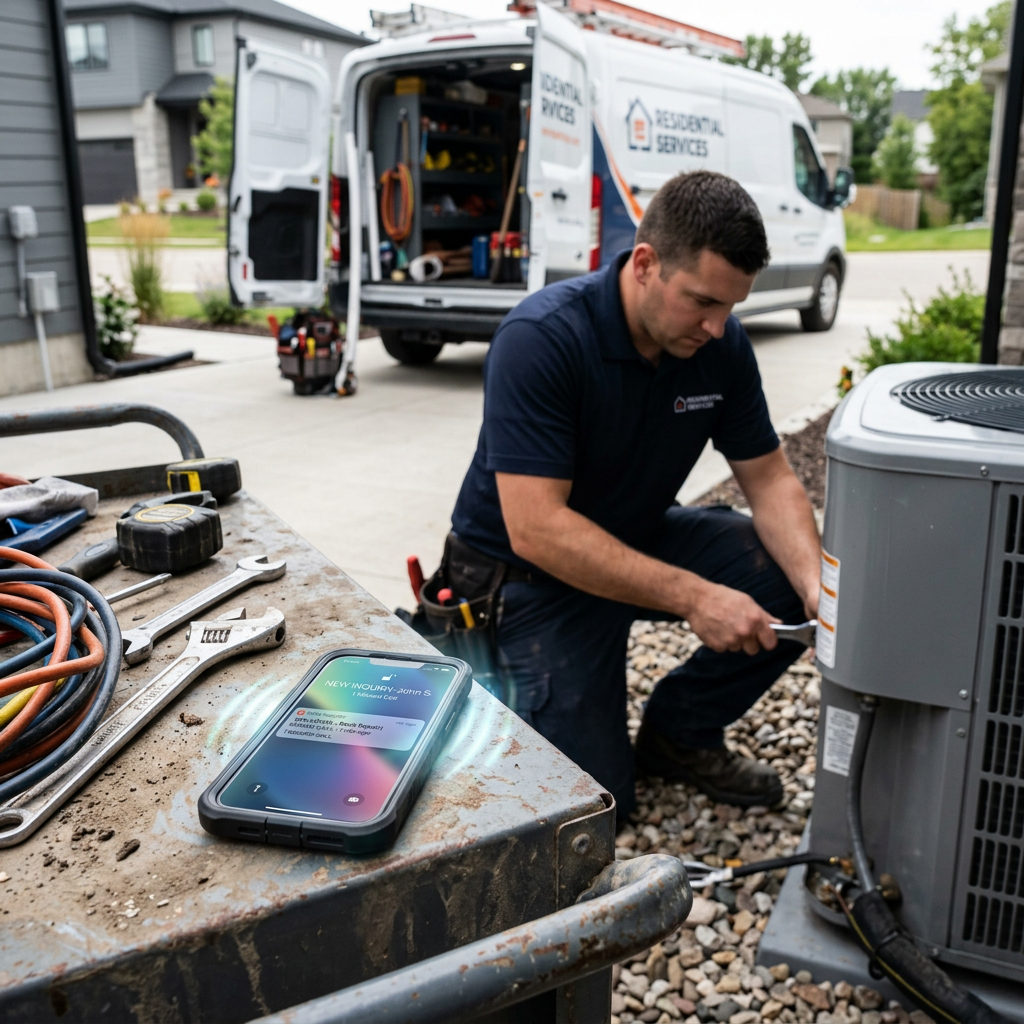
Automated Lead Follow-Up Can Dramatically Increase Your Closed Jobs
Here’s the part where the numbers get interesting. One contractor profiled by PushLeads (2023) implemented automated follow-up and saw conversion rates jump from 28% to 54%. Same number of leads. Same marketing spend. Results will vary by business, but the pattern is clear: faster, more consistent follow-up closes more jobs.
That’s not a small improvement. That’s the difference between a contractor who’s scraping by and one who’s turning down work.
What does automated follow-up actually look like? Modernize (2025) outlines what they call a “winning cadence” for contractors. An automated text goes out within zero to one minute of the inquiry, acknowledging it and letting the homeowner know you’re on it. An automated email follows in the same window with more detail. Then a phone call happens at the two-to-five minute mark, after the text has primed the homeowner to recognize your company name when the phone rings.
That sequence does something important. It tells the homeowner, before you’ve even spoken to them, that you’re professional, responsive, and organized. Predictive Sales AI (2025) notes that fast follow-up builds trust because it signals reliability and respect for the homeowner’s time.
And here’s a detail that matters: most homeowners prefer text or email over a phone call for initial contact with a contractor. Modernize (2025) reports that only a small fraction prefer a phone call as the first touchpoint. So the contractor who’s been thinking “I just need to call them back” is actually using the wrong channel for most homeowners. A text-first approach meets them where they’re comfortable.
Convoso (2023) recommends combining outbound calling with automated SMS and email to deliver both speed to lead and speed to contact. They also recommend drip campaigns to re-engage leads who don’t respond initially. Because not every homeowner is ready to book right now, but they might be ready next week if you stay in front of them.
Simple Systems Beat Hard Work Alone for Lead Follow Up as a Contractor
There’s a quote from James Clear that Modernize (2025) applies to contractors: “You do not rise to the level of your goals. You fall to the level of your systems.” Every contractor wants to close more jobs. But wanting it doesn’t help when you’re elbow-deep in a plumbing repair and your phone is ringing in the truck.
You’ve built this business on hard work. But hard work alone can’t answer the phone while you’re on a job. You can’t physically pick up every call while doing the work. You can’t mentally track every lead while you’re focused on an install. And you shouldn’t have to.
Traderise Advisors (2024) found that many reps make one call and then abandon the lead instead of persisting through five or more touches. They also emphasize that speed to lead is the single most predictive factor in the entire lead lifecycle. Top home services companies track time to first contact daily. They treat lead response as margin management, not just sales activity.
That might sound like something only big companies do. But the tools to do it are available to one-truck operations now. Your competitors are already using this. The ones answering calls at 9pm on Saturday are the ones getting those jobs.
Think about it this way. It’s 9pm on a Saturday and a homeowner’s water heater just died. They’re searching on their phone, clicking through Google results, and calling contractors. The one who answers, even if it’s an AI receptionist that takes their information and books a Monday morning appointment, wins that job. The contractors whose phones go to voicemail don’t even get considered.
Modernize (2025) is direct about this: automation is the only way to beat competitors to the lead in 2026. Manual call-first workflows are being replaced with text-first, call-second strategies. The contractors still relying on “I’ll call them back when I’m done” have already lost to the company using automation.
The Leads You’re Already Paying For Are Enough
Most contractors don’t need to spend more on marketing. They need to stop wasting the marketing they’ve already paid for. When your leads cost $90 or more each and most homeowners hire whoever responds first, the math is simple. A system that responds instantly pays for itself many times over.
You don’t need to become a tech expert. You don’t need to overhaul your business. You need something that picks up the phone when you can’t. That sends that first text within a minute. That makes sure no lead sits in your voicemail until you’re driving home at 6pm.
If you want to see what that looks like in practice, call our AI receptionist at +1 587-742-8858 and hear how it handles an incoming call. It’s trained for home services businesses like yours. We set it up, you approve it, and it goes live. Your leads get answered. Your marketing dollars stop going to waste. And the next time your phone buzzes while you’re on a ladder, you won’t have to choose between the job in front of you and the one calling in.