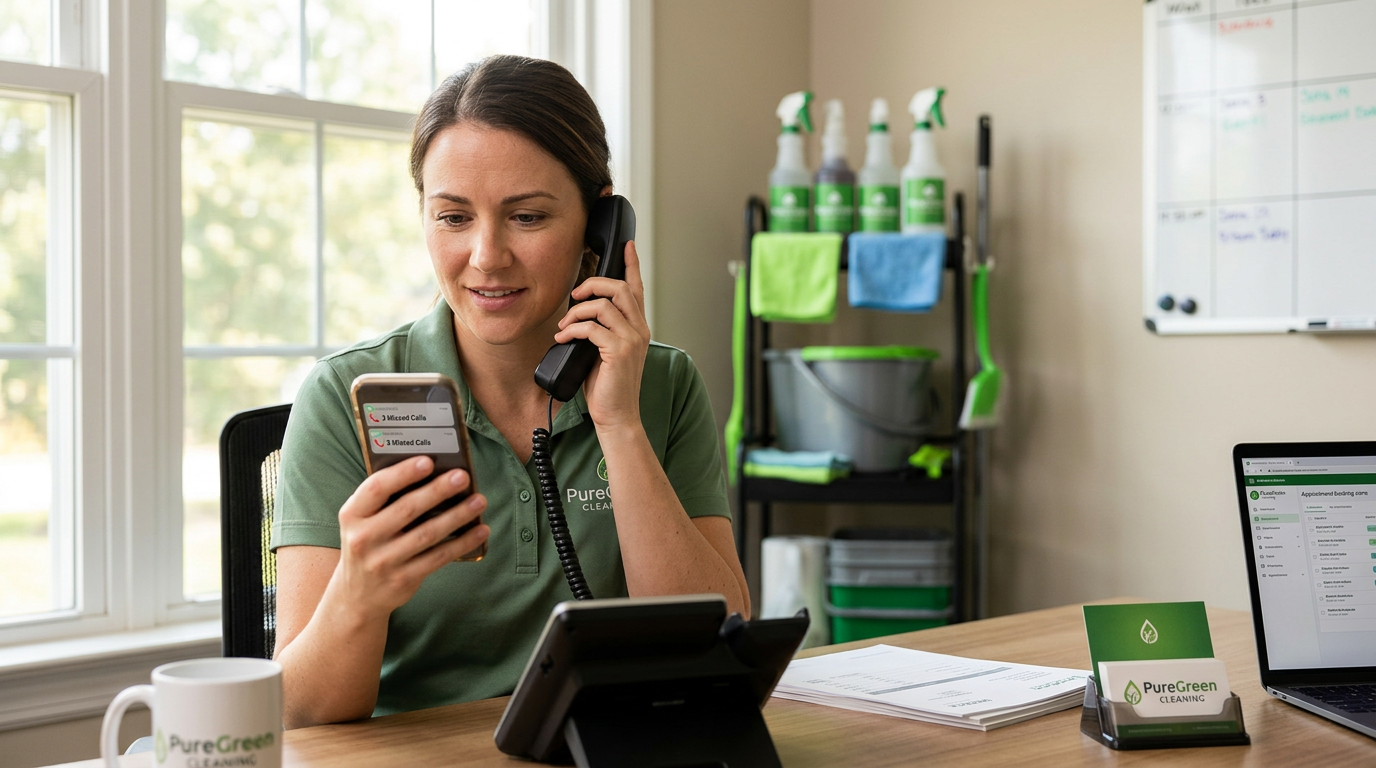
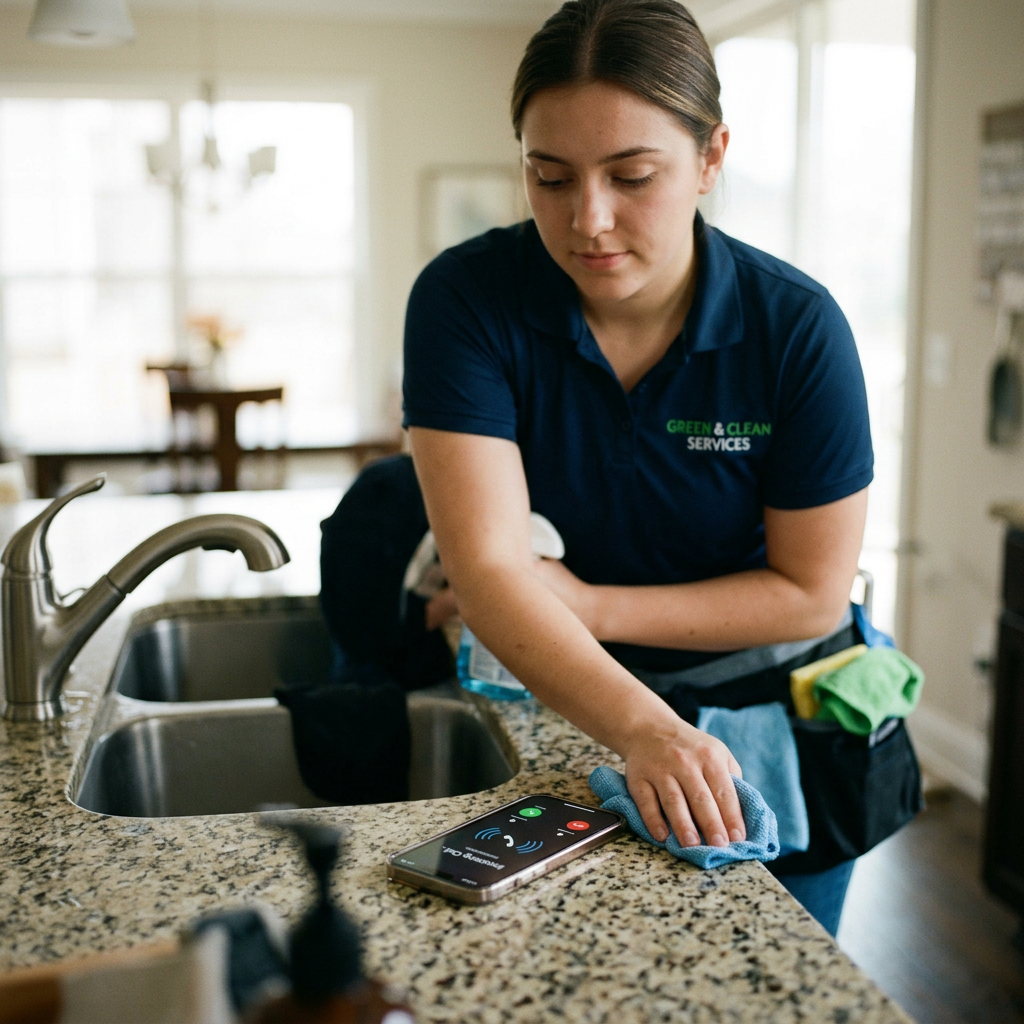
It’s Monday at 9:15 AM. You’re in the supply closet restocking your van for the week’s jobs, and three calls come in back to back. By the time you peel off your gloves and grab your phone, all three have gone to voicemail. You check the caller ID later that evening. One was a new lead from Google. One was a property manager with five units. And one was Mrs. Johnson, your bi-weekly deep clean client of 18 months, calling to reschedule. She didn’t leave a message. None of them did. Mrs. Johnson ended up booking with the competitor who picked up on the first ring. Cleaning company phone answering isn’t glamorous. But it’s the difference between a business that grows and one that slowly bleeds clients it already earned.
This isn’t a one-off bad morning. It’s the pattern most cleaning business owners live with every week. And the cost is bigger than you think, because it’s not just about the call you missed today. It’s about the recurring revenue you’ll never see.
Every Missed Cleaning Company Phone Call Puts Recurring Revenue at Risk
A missed call to a cleaning business could represent anything from a one-time move-out clean to the first booking of what becomes a weekly account. The range is wide, but every unanswered call is a door that closes before you even know it opened. And the problem compounds fast when you consider how many calls actually go unanswered.
Many small cleaning businesses answer fewer than half of their incoming calls. The rest go to voicemail or just ring out. And CallRail surveyed a thousand consumers in 2025 and found only 42% leave a voicemail when a business doesn’t pick up. They hang up and call the next company on the list. Your competitor doesn’t have to be better than you. They just have to pick up the phone.
The numbers get worse after hours. Most cleaning businesses stop answering calls outside the standard 9-to-5 window, but that’s exactly when a huge share of inquiries come in. Evenings, early mornings, and weekends are when homeowners are actually home, actually thinking about their house, and actually motivated to pick up the phone. The majority of your potential clients are calling when nobody’s there to answer.
There’s another layer to this. Customers who first connect with your business by phone tend to become recurring clients at a higher rate than those who come through other channels. They’re the ones who want to talk through their needs, get a feel for your professionalism, and build enough trust to hand you a house key. When those calls go unanswered, you’re not just losing a single job. You’re losing the kind of client who pays you every two weeks for years. If you want to see how the math on missed calls works across industries, the numbers are consistent. Cleaning businesses are no exception.
Why Cleaning Clients Demand Immediate Phone Responses
Cleaning is a trust business. You’re asking someone to let a stranger into their home, often while they’re at work. That trust starts with the very first interaction. And for most first-time customers, that first interaction is a phone call. Not a web form. Not an online booking widget. A phone call where they can ask questions, explain their space, and decide if you sound like someone they’d trust with their home.
When that call goes to voicemail, the trust-building never starts. The caller doesn’t think “I’ll try again later.” They think “this company doesn’t have it together” and move on. According to a 2023 Invoca study, the vast majority of callers who don’t reach a business on the first try will choose a competitor who answers immediately rather than wait and call back. That’s not a preference. That’s a near-unanimous verdict.
Timing matters too. Evening calls between 6 and 9 PM tend to have higher booking intent than calls during other hours. These are people sitting on their couch after work, finally getting around to calling about that deep clean they’ve been putting off. They’re ready to book right now. But if your phone rings to voicemail at 7:30 PM, that motivation evaporates. By the time you call back the next morning, they’ve either booked with someone else or lost the urgency entirely.
Monday mornings are the other peak. People come home from the weekend, look at their house, and decide they need help. That window between 8 and 11 AM generates far more inquiries than any other time of the week. And you’re probably loading your van or already on your first job. The cleaning business missed calls problem isn’t about negligence. It’s about the reality that you can’t clean a house and answer a phone at the same time.
How Answering Every Call Turns One-Time Jobs into Recurring Clients
Speed wins in this business. According to a 2023 Lead Connect study, businesses that respond to inquiries within 5 minutes convert at 8x the rate of those that respond in 30 minutes. The difference between a five-minute callback and a thirty-minute callback is the difference between booking the job and never hearing from that person again.
This is especially true for businesses where leads come in between jobs. Contractors and cleaning companies share the same problem: your best working hours are also your best lead-generation hours, and you can’t do both at once.
Now consider what happens when you do answer. That first-time caller books a one-time deep clean. You do a great job. They call back a month later for another. Then they ask about a recurring schedule. Industry experience consistently shows that recurring clients are worth many times what a one-time customer brings in. That means a client on a recurring schedule becomes your most valuable customer type. Every call you answer is a chance to start that cycle. Every call you miss is a cycle that never begins.
There’s real-world proof this works. Cleaning businesses that implement professional call handling with automated confirmations and SMS reminders consistently see significant drops in cancellations and no-shows. That’s not because the cleaning gets better. It’s because the communication gets better. Clients feel taken care of from the moment they call. They show up, they rebook, and they stay.
The connection between answering the phone and building recurring clients isn’t complicated. People want to feel like they matter to your business. When they call and get a real response, whether from a person or a well-trained AI receptionist, they feel that. When they get voicemail, they don’t.
Practical Ways to Fix Cleaning Company Phone Answering for Good
You have a few options, and the right one depends on the size of your operation and how many calls you’re missing.
Staff scheduling around peak call times. If you have a team, make sure someone is available to answer phones during Monday mornings (8 to 11 AM) and weekday evenings (6 to 9 PM). Those two windows account for a disproportionate share of high-intent calls. Even shifting one team member’s start time by an hour on Mondays can make a measurable difference. The problem is that this only works if you have the staff, and most small cleaning businesses don’t have a dedicated receptionist.
Traditional answering services. A live answering service can cover your phones when you can’t. They typically cost between $200 and $1,000 per month depending on call volume. The upside is a human voice. The downside is that the person answering doesn’t know your business the way you do. They’re reading a script. They can take a message, but they usually can’t book an appointment, answer questions about your services, or handle a rescheduling request. For many cleaning businesses, that’s not enough.
An AI receptionist that knows your business. This is what we built GoodHelpAI to do. Your AI receptionist answers every call, 24/7, on the first ring. It knows your services, your pricing, your availability. It can book appointments, answer common questions, and send confirmation texts. It handles the Monday morning rush and the Tuesday night “can you come this week?” call the same way. And it charges the same amount every month, no matter how many people call. The difference between an AI receptionist and a generic answering service is the same difference between a trained employee and a temp who showed up five minutes ago. One knows your business. The other is just picking up the phone. You can see how this works for home service businesses like yours on our site.
Automated SMS confirmations. Whatever phone system you use, pair it with automated text confirmations and reminders. Businesses that add this step consistently see fewer cancellations and no-shows. A simple text that says “Your cleaning is confirmed for Thursday at 10 AM” does more for client retention than most marketing campaigns. It tells the client you’re organized, professional, and paying attention.
The Real Cost of Doing Nothing
Here’s a simple exercise. For one week, track every call you miss. Check your voicemail log, your missed call list, and any calls that went unanswered after hours. Count them up.
Now think about what each of those calls might have been. A new client inquiry. A rebooking request. A schedule change that, if handled quickly, would have kept a long-term client on your roster. Most of those callers didn’t leave a message. They called someone else. And you’ll never know what you lost because the call just shows up as a number you don’t recognize.
Cleaning businesses run on recurring clients. That’s the whole model. You do great work, people keep you on the schedule, and your revenue becomes predictable. But the pipeline to those recurring clients starts with a phone call. And if nobody answers that call, the pipeline is broken before it begins.
You don’t need to overhaul your business. You just need to make sure the phone gets answered. Every time. Even when you’re on a job, in the van, or closed for the night.
If you want to hear what it sounds like when your AI receptionist picks up a call for your cleaning business, try it yourself. Call +1 587-742-8858 and see how it handles the conversation. Or book a quick call with our team. We’ll show you exactly what your callers hear, and what happens next so those calls turn into recurring clients instead of missed opportunities.