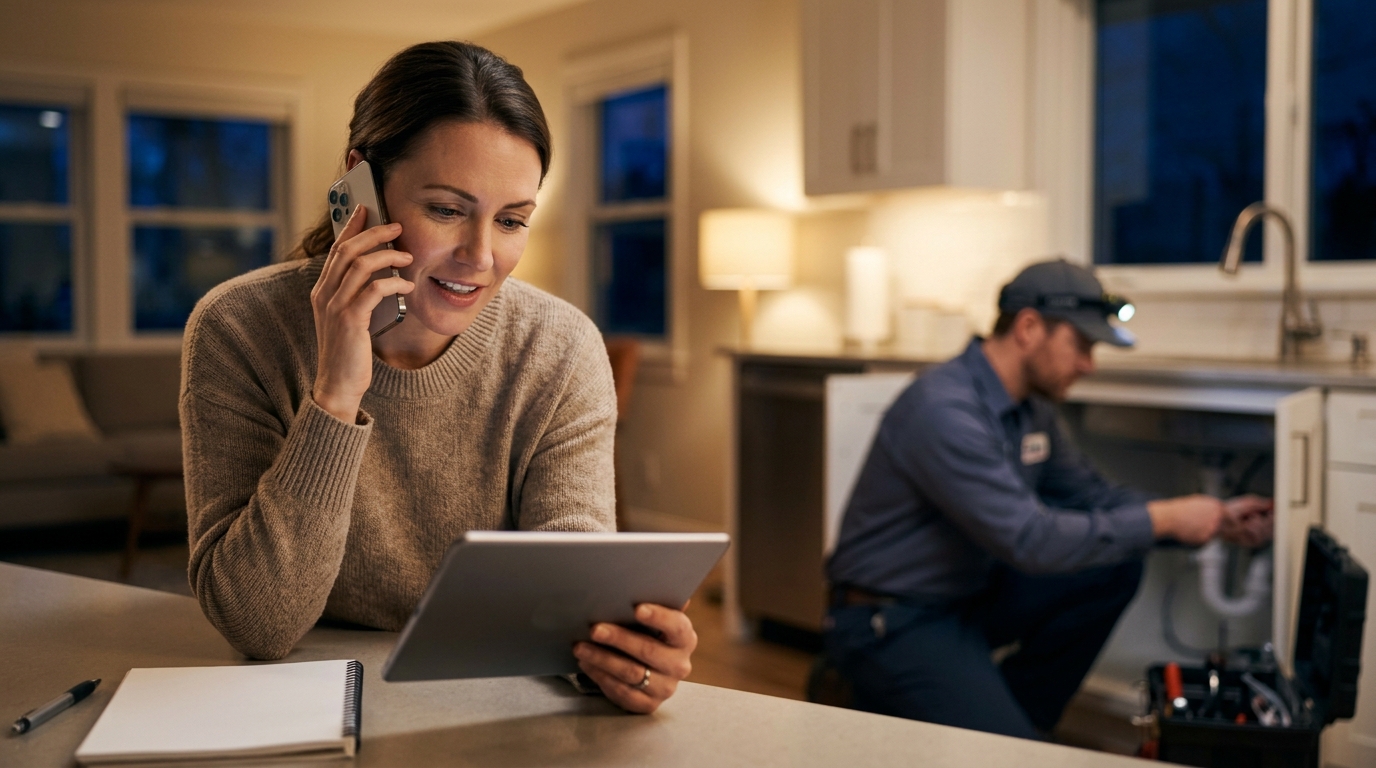
It’s 9:30 PM on a Sunday. Your phone rings. Someone’s basement is flooding, and they need a plumber right now. But your business phone goes to voicemail, and they don’t leave a message. They tap the back button and call the next name in the search results. By Monday morning, you don’t even know that call happened. The job, the customer, the referral they would have sent you next month: all gone to whoever picked up first. That’s the cost of missing after hours business phone coverage, and it happens more often than most business owners realize.
Here’s the math that should bother you. If your business is open 40 hours a week, that leaves 128 hours where nobody’s answering. That’s 76% of every week. Three quarters of the time, your phone rings into nothing.
And it’s not like people stop needing things at 5 PM on a Friday.
After-Hours Calls Are a Major Revenue Leak
Most small business owners know they miss some calls. What they don’t know is how many, and what those calls are actually worth.
According to BrightLocal’s 2025 Local Consumer Review Survey, small businesses lose about 27% of potential customers who call outside business hours. That’s not a rounding error. That’s more than a quarter of the people trying to give you money, gone before you even knew they existed.
A 411 Locals study across 85 businesses in 58 industries found that small and mid-sized businesses only answer 37.8% of all inbound calls. Another 37.8% go to voicemail. And 24.3% get no response at all. Not even a voicemail option. Just ringing into the void.
The after-hours window is where the problem concentrates. During business hours, you might miss a call because you’re with a customer or your front desk is slammed. After hours, you miss every single one. And CallRail surveyed a thousand consumers in 2025 and found only 42% leave a voicemail when a business doesn’t pick up. The other 58% just hang up and call your competitor. Voicemail is not a safety net. It is a dead end.
Even 30 missed calls per month adds up fast. Depending on your industry and average job value, that kind of volume can represent a significant share of annual revenue you never had a chance to earn. The calls aren’t disappearing. They’re going to whoever answers first.
Why Customers Hang Up and Never Call Back
There’s a gap between what business owners assume and what actually happens when a call goes unanswered.
The assumption: “They’ll leave a voicemail, and I’ll call them back in the morning.”
The reality: most callers abandon a business entirely after an unanswered call. They don’t try again. They don’t leave a message. They don’t send an email. They call someone else.
And it makes sense if you think about it from the caller’s perspective. They have a problem right now. Their AC died at 11 PM in August. Their toilet is overflowing. They got rear-ended and need a body shop. They’re not browsing. They’re buying. And most customers expect an immediate response when they call a business. Voicemail doesn’t meet that expectation. It fails it completely.
Emergency-service businesses feel this the hardest. HVAC systems don’t fail on a schedule. Pipes burst on weekends. Lockouts happen at 2 AM. If you’re a plumber, an HVAC tech, or any trade that handles urgent work, your highest-value calls often come at the worst possible times. The calls that represent the biggest jobs, the most grateful customers, the best reviews, those come when you’re asleep or at dinner or trying to have a day off.
And every one that goes unanswered goes to your competitor down the road who figured this out before you did.
The Hidden Cost of Letting Your Phone Ring Out After Hours
Missed calls don’t just cost you one job. They compound.
Consider a business getting 10 inbound calls per day, roughly 300 a month. If that business misses 40% of after-hours calls (which is common), that’s 120 missed calls every month. That’s 120 people who wanted to hire you and couldn’t get through.
Now look at what happens to those calls depending on how they’re handled. According to BrightLocal’s research, voicemail converts at roughly 15%. That means out of every 100 people who hear your voicemail greeting, maybe 15 actually leave a message and eventually become customers. The other 85 are gone.
Compare that to a service that actually picks up the phone. Whether it’s an AI receptionist or a live answering service, businesses that answer after-hours calls consistently see conversion rates two to three times higher than voicemail. Same calls, same customers, wildly different results based purely on whether someone (or something) answers.
Here’s a real example. Jake owns an HVAC company in Phoenix. During his first summer, he forwarded calls to his personal phone 24/7. “I was getting calls at 2 AM from people whose AC died,” he said. “After three months I was losing my mind. My wife threatened to throw my phone in the pool.” When he switched to 24/7 call coverage, he started capturing calls that had been going to voicemail for months. Not new marketing. Not new ads. Just answering the phone that was already ringing.

How to Fix Your After Hours Business Phone Coverage
You have a few options, and the right one depends on your call volume, your budget, and how complex your calls tend to be.
Option 1: An AI receptionist. This is the most cost-effective path for most small businesses. Your AI receptionist answers every call, 24/7, on the first ring. It’s trained on your business, so it knows your services, your hours, your service area, and your pricing. It can book appointments, capture caller information, answer common questions, and route urgent calls according to your rules. And the cost is a fraction of hiring a person to sit by the phone all night.
Option 2: A live virtual receptionist service. Higher cost, but you get a real human on the other end. This makes sense for businesses where calls are complex or emotionally sensitive, like law firms handling intake for new clients or medical practices fielding patient concerns. The per-minute pricing adds up, but for high-value calls it can be worth it.
The critical thing with either option: you need something that asks what the caller needs, not just who they are. A voicemail that says “Hi, call me back” gives you almost nothing to work with. A service that asks what the caller needs, when they need it, and how urgent it is gives you everything you need to close the job before your competitor even wakes up.
Most businesses doing under 100 calls a month will find that an answering service, whether AI or human, pays for itself within the first month just from the conversion rate difference alone. The math works because voicemail is that bad, not because the service is that expensive.
Real Businesses That Closed the After-Hours Gap
Sarah runs a plumbing company in Austin. For her first two years, she relied on voicemail after hours. “I’d come in Monday morning to 6 missed calls and zero messages,” she said. “By the time I called those numbers back, they’d already hired someone else.” After adding 24/7 call coverage, her business went from losing those Monday morning calls to booking 22 after-hours jobs per month. Same marketing spend. Same service area. The only thing that changed was that someone answered the phone.
A mid-size law firm saw similar results. By making sure no call went unanswered, day or night, they started converting leads they’d already been paying for. They weren’t spending less on marketing. They were just picking up the phone when it rang. Every unanswered call had been a lead they’d already bought and then thrown away.
The common thread in both cases: the service paid for itself fast. Not over a quarter. Not over a month. Within the first couple of weeks. Because the calls were already coming in. The revenue was already there, waiting to be captured. The only thing missing was someone to pick up.
This pattern holds across industries. Your competitors who figured this out aren’t necessarily running better ads or offering lower prices. They’re just answering the phone when you’re not.
128 Hours Is a Long Time to Leave Your Phone Unattended
Your business is open 40 hours a week. Your customers need things 168 hours a week. That 128-hour gap isn’t a minor inconvenience. It’s the majority of the week, and it’s when some of your most motivated, most urgent, highest-value callers are trying to reach you.
The data is clear. In that same CallRail survey, 82% of consumers said they would call a competitor instead of waiting for a call back. Businesses that answer after hours convert at significantly higher rates than businesses that don’t. And the callers you’re missing aren’t window shoppers. They’re people with a problem right now, ready to pay whoever picks up.
You don’t need to answer the phone yourself at midnight. You don’t need to hire a night shift. You just need something that picks up, handles the call the way you would, and has the information waiting for you in the morning. Or better yet, books the appointment before you even wake up.
If you want to hear what that sounds like, call our AI receptionist at +1 587-742-8858 and test it yourself. It picks up on the first ring, every time, 128 hours a week included.