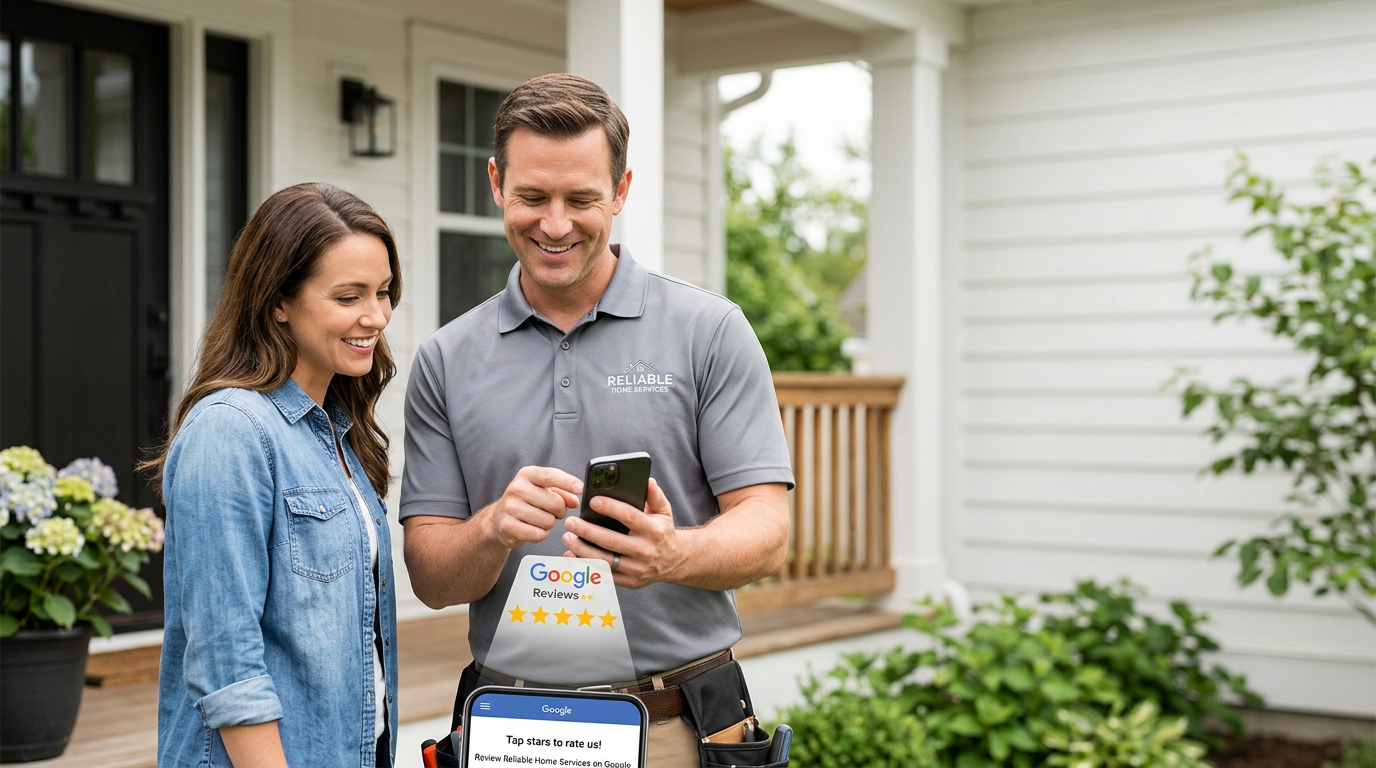
You just finished installing a new kitchen for a couple who couldn’t stop thanking you. The countertops look perfect. The backsplash is exactly what they wanted. They paid the final invoice on the spot, shook your hand, and said they’d recommend you to everyone they know. You drive away feeling good. Then, halfway home, it hits you: you forgot to ask for a Google review. Again. This is why automated review requests exist. Not because you don’t care about reviews, but because you’re already thinking about tomorrow’s job before today’s is even cold.
That kitchen client meant it when they said they’d tell their friends. But “meaning to” and “doing it” are two different things. Without a prompt, most happy clients never leave a review. They get home, start cooking dinner, and your five-star experience fades into the background of their busy lives. The window closes. And your Google profile stays exactly where it was.
The good news: fixing this doesn’t require you to change how you work. It just requires a system that remembers to ask, even when you don’t.
Why Automated Review Requests Outperform Manual Follow-Ups
You already know reviews matter. A strong Google profile is the difference between getting the call and getting skipped. But knowing reviews matter and consistently collecting them are two very different problems. One is awareness. The other is execution. And execution is where most contractors fall short, not because they’re lazy, but because they’re busy doing actual work.
Think about how manual review requests typically go. You finish a job. You tell yourself you’ll text the client later. Then you get a call about a leak across town, your supplier messes up a delivery, and by the time you sit down at night, asking Mrs. Johnson for a Google review is the last thing on your mind. Multiply that by every job you complete in a month.
Contractors who follow up with clients after the job consistently report more referrals and repeat business than those who go silent after final payment. That shouldn’t be surprising. Staying in touch keeps you top of mind. And automated review requests are the simplest form of post-job follow-up there is. You don’t have to write a thank-you card or make a phone call. The system sends a text with a review link, and you move on with your day.
Your field crews shouldn’t be responsible for this. They’re focused on the next job, as they should be. A plumber finishing a water heater install at 4pm is already mentally prepping for the morning’s first call. An HVAC tech wrapping up a furnace replacement in January isn’t thinking about your Google profile. Asking them to also manage customer follow-up is like asking your best carpenter to handle your bookkeeping. It’s not their job, and it won’t get done consistently. Automation takes this off everyone’s plate. Every client gets asked, every time, without anyone on your team having to remember.
How Automating Review Requests Saves You Real Money
Reviews aren’t just about reputation. There’s a direct financial case for automating the process, and it’s more straightforward than you might think.
Consider what manual follow-up actually costs you. Your office manager spending 20 minutes a day chasing clients for feedback. The sticky notes that fall off the dashboard. The spreadsheet that’s three weeks out of date. The client who was thrilled on Tuesday but can barely remember the details by the following week. All of that has a cost, even if it doesn’t show up on a line item.
When you stop relying on manual processes for repetitive tasks, you free up hours that were costing you real money. Contractors who automate their post-job follow-up consistently report getting more reviews with less effort, and getting them faster. That matters because a review left the same day as the job is more detailed, more enthusiastic, and more useful to the next homeowner reading it than one left three weeks later after your third reminder.
There’s another angle worth mentioning. For contractors who deal with retainage, getting clients to complete satisfaction surveys faster means faster retainage release. When your automated system sends a satisfaction check-in right after job completion, clients respond while the work is still fresh. That means quicker sign-off, which means your cash isn’t sitting in someone else’s account for an extra month. Contractors who automate this part of closeout regularly report cutting weeks off the process.
If you’re already losing leads between jobs, as we covered in our piece on the cost of poor lead follow-up for contractors, losing reviews on top of that is compounding the problem. Every job you complete without collecting a review is marketing value left on the table.
What the Best Automated Review Systems Actually Include
Not all review automation is created equal. Some tools send a generic email three days after a job and call it done. That’s better than nothing, but it’s not much better. The systems that actually move the needle share a few specific traits.
First, the request needs to be mobile-friendly. Your clients are on their phones. If they have to pinch and zoom to find the review link, or if it takes more than one tap to get to the Google review form, you’ve already lost most of them. The best systems send a text message with a direct link that opens the review page immediately. One tap. That’s it.
Second, timing matters more than you’d think. The ideal moment to ask for a review is within hours of completing the job, while the client is still admiring the new tile or enjoying their first hot shower from the water heater you just installed. That means your review system needs to connect with your scheduling or job management software. When a job gets marked complete, the request goes out automatically. No delay, no manual trigger, no forgotten follow-up.
Third, you need a follow-up sequence. Not everyone responds to the first message. Life gets in the way. A good system sends a polite reminder a few days later, and maybe one more after that. Not pushy. Just persistent enough to catch people when they have a free moment. Think of it like how you’d follow up on an unpaid invoice, except friendlier and with much less at stake for the client.
What Contractors Actually See When They Automate Reviews
The pattern from contractors who’ve adopted review automation is consistent: less manual work, more reviews, better Google visibility.
Think about your own numbers. If you’re completing 20 jobs a month right now, you’re probably asking for reviews on maybe five or six of them, if that. And of those, maybe two or three actually leave one. Automation means all 20 get a request. According to a 2023 BrightLocal consumer review survey, 65% of consumers have left a review after being directly asked by a business. That’s a big jump from the handful you’re collecting now.
The consistency matters as much as the volume. Google’s local search algorithm favors businesses with a steady stream of recent reviews over those with a burst of reviews from six months ago. When every completed job triggers a review request, you build that steady stream without thinking about it. A roofer who finishes 15 jobs a month and automates review requests will accumulate reviews faster than one who does 30 jobs but only remembers to ask occasionally.
If you’re thinking about growing your business, this matters even more. If you grow to 40 jobs a month next year, all 40 still get a request, with zero additional effort from your team. The review volume scales with your workload automatically.
This is the same dynamic we see with missed calls costing small businesses real money. The problem isn’t that you don’t want to follow up. The problem is that manual processes don’t keep up with your workload. Automation does.
How to Implement Review Automation Without Disrupting Your Workflow
If you’re reading this and thinking “sounds great, but I don’t have time to set up another system,” that’s a fair concern. Here’s how to do it without turning your operation upside down.
Start small. Pull up your last 10 completed jobs and identify the ones where the client was clearly happy. Send those folks a review request first. This gives you quick wins, builds momentum, and lets you see results before you commit to a full rollout. Happy clients from recent jobs are the easiest wins you’ll find, and most of them will respond if you just ask.
Next, get your field teams comfortable with whatever tool you choose. Make it simple. If your crew has to do anything more than tap “job complete” on their phone, you’re asking too much. The review request should trigger from that single action, or better yet, from a status change in your existing scheduling software. Most contractors find their teams pick this up faster than expected once they see it doesn’t add work to their day.
Speaking of existing software: whatever review automation you use should connect to what you already have. Your accounting software, your scheduling tool, your CRM if you use one. The goal is to add a layer on top of your current workflow, not replace it. If a tool requires you to change how you dispatch jobs or track clients, it’s the wrong tool.
Review automation handles the back end of your customer relationship, making sure happy clients actually say so on Google. But there’s a front end that matters just as much: making sure the phone gets answered when new clients call in the first place. A contractor with 200 five-star reviews still loses the job if nobody picks up when the homeowner calls. We wrote about how competitors are already turning missed calls into wins, and the same logic applies here. If you’re not collecting reviews and you’re not answering every call, someone else is doing both.
Google Reviews Are the Marketing That Actually Works
For most home service businesses, Google reviews are the single most influential factor in whether a new customer calls you or calls the next name on the list. Not your website design. Not your truck wrap. Not your ad spend. Reviews.
A homeowner with a flooded basement at 9pm on a Saturday isn’t comparing websites. They’re scanning Google Maps, looking at star ratings and review counts, and calling whoever looks most trustworthy. If you’ve got 47 reviews and a 4.8 rating, and the guy down the road has 12 reviews and a 4.2, you’re getting that call. Every month of automated requests adds to your total review count, which improves your local search ranking, which brings in more calls, which creates more jobs, which generates more reviews. That cycle runs on its own once you start it.
Your happiest clients genuinely want to help you out. They just need to be asked at the right moment, in a way that takes them 30 seconds. Automated review requests make that happen without adding a single task to your day.
Stop Leaving Five-Star Reviews on the Table
The math here is simple. You’re already doing great work. Your clients are already happy. The only thing missing is a system that asks them to say so publicly, consistently, every single time. That’s all automated review requests do. They close the gap between a happy client and a Google review.
And if you’re wondering whether your phone setup is costing you the leads those reviews are supposed to bring in, give our AI receptionist a call at +1 587-742-8858 and hear how it handles incoming calls for contractors. It picks up every call, 24/7, so the new customers reading your reviews can actually reach you. Or book a quick call to see how it works with your existing setup. Your next five-star review is sitting in a happy client’s pocket right now. They just need a nudge.