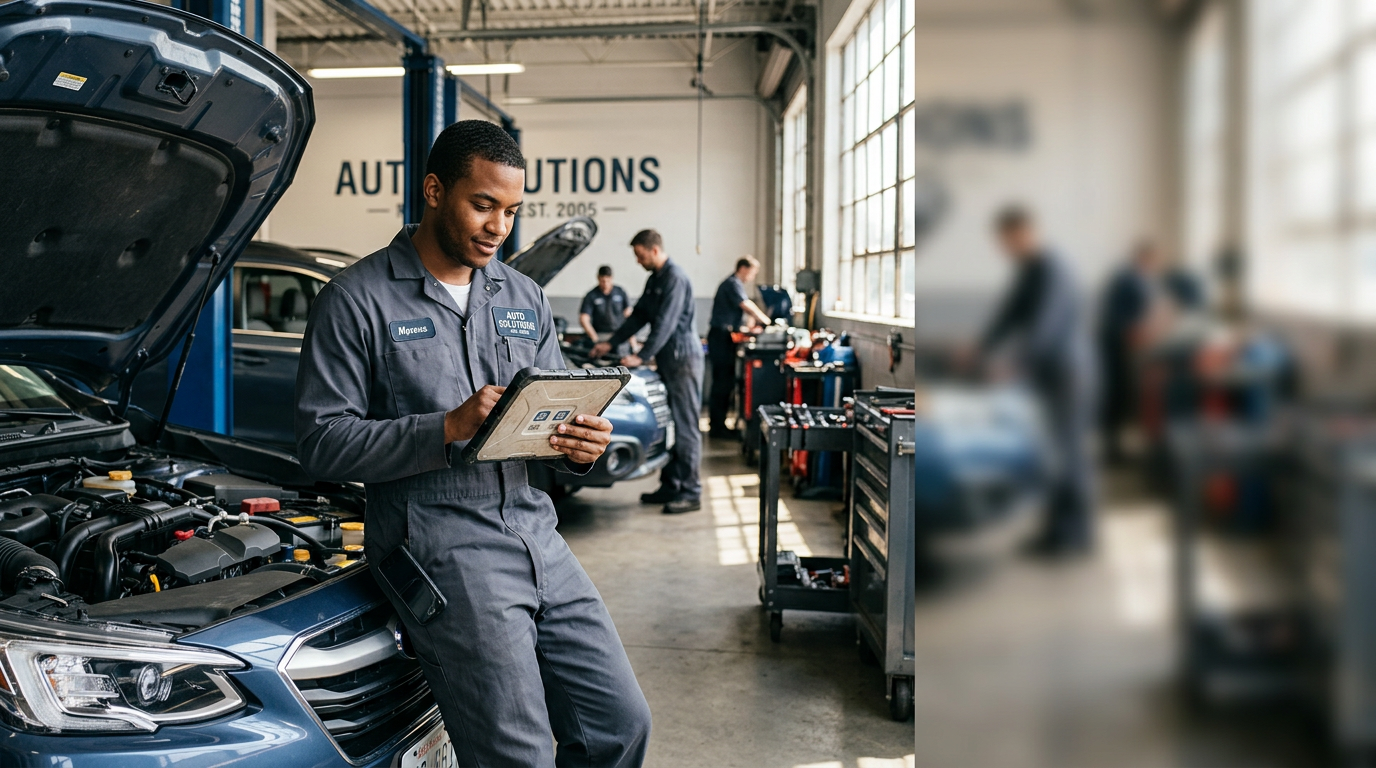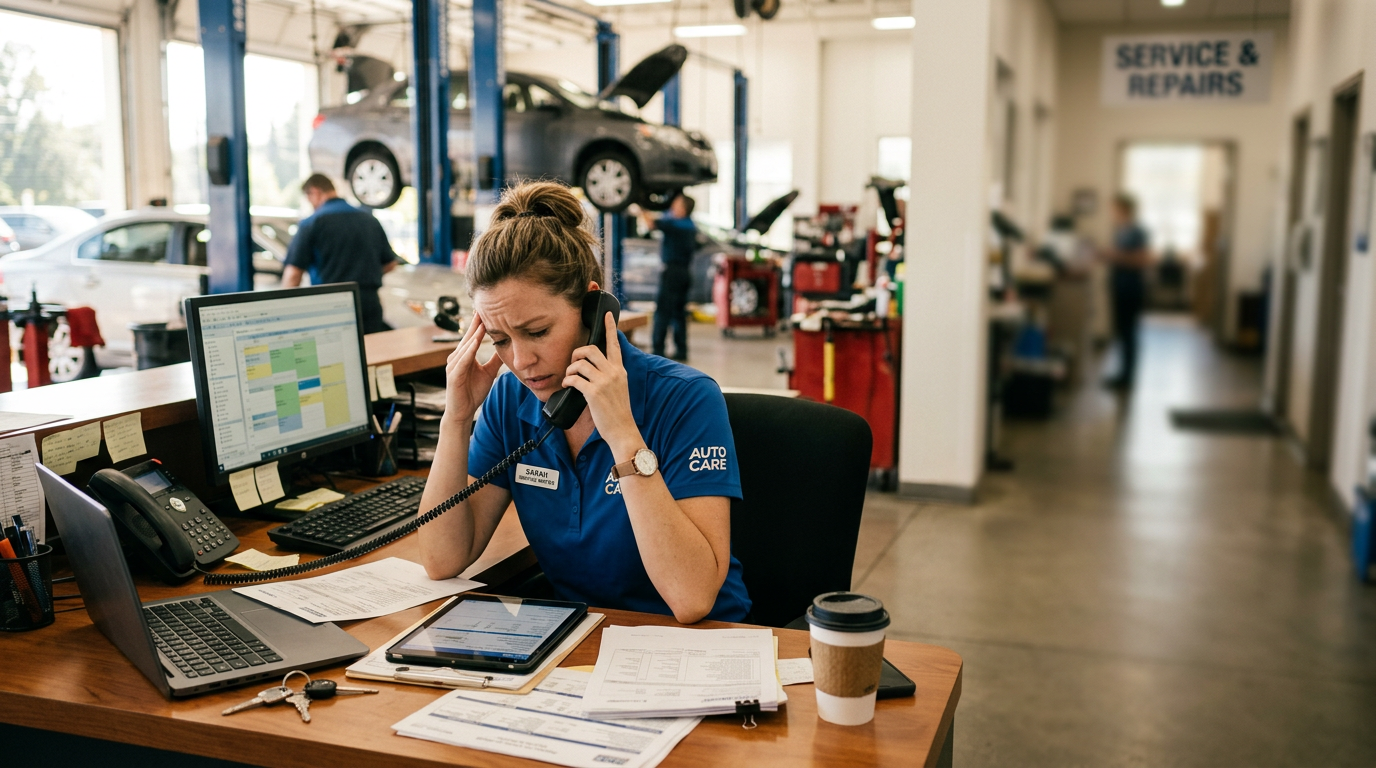
It’s 10 AM on a Monday. Your auto shop service writer is overwhelmed before the morning’s half over. Three customers are standing at the counter. The phone is ringing. A tech just walked up to ask about a part that didn’t come in on Friday’s delivery. Your service writer is trying to build an estimate, answer a question about a timing belt, and ring someone out at the same time. The phone stops ringing. Whoever was calling just moved on to the next shop in their search results. That might have been a $1,200 brake job. You’ll never know.
This isn’t a bad day. This is a Monday. And if your auto repair front counter looks like this on a regular basis, you’re not alone. But you are losing money.
Why Your Auto Shop Service Writer Is Overwhelmed Every Single Day
At a dealership, the service writer writes service. That’s the job. Someone else answers the phone. Someone else runs parts. Someone else handles the register. At your independent shop? Your service writer does all of it. They’re the advisor, the cashier, the phone operator, the parts chaser, and sometimes the person explaining to a customer why their car isn’t ready yet because a part is backordered for the third week in a row.
Most service advisors do their best work when they’re not juggling more than about 20 to 25 ROs a day. Beyond that, communication quality drops, follow-ups get missed, and mistakes start creeping into estimates and scheduling. That makes sense when you think about it. There are only so many hours in a day, and each RO involves customer communication, parts sourcing, tech coordination, and billing.
Now layer on the technician shortage. According to a 2025 report from PartsTech and the Automotive Management Network, 31% of auto repair shops say technician shortages are their biggest challenge. When you can’t move work through the bays fast enough, your service writer is stuck managing customer expectations for delays they can’t control. Some advisors report customers waiting four to five months for a single part. That’s not a one-time phone call. That’s months of follow-up conversations, loaner car logistics, and frustrated customers who need updates.
Your service writer isn’t bad at their job. They’re doing five jobs at once, and the phone keeps ringing while they do it.
The Hidden Costs When Your Front Counter Can’t Keep Up
When your service writer is buried, the first thing that drops is communication. Not because they don’t care, but because the person standing in front of them takes priority over the person calling on the phone. That’s human nature. It’s also expensive.
Many vehicle owners report dissatisfaction with their service experience, and the biggest reasons tend to be unexpected costs and poor communication. Think about that. It’s not the price of the repair that bothers people most. It’s the feeling of being left in the dark. The estimate that changed without a heads-up. The call that never came to say the car was ready. The question they asked that nobody followed up on.
Every one of those failures traces back to the same root cause: your service writer had too much going on and something slipped. And the customer doesn’t see the chaos behind the counter. They just see a shop that doesn’t communicate well.
Then there are the shop phone calls that never get answered. A ringing phone during a rush isn’t just noise. It’s a potential customer who needs a repair, wants a quote, or is ready to book. If nobody picks up, most of them won’t leave a voicemail. They’ll call the next shop. Your competitor gets the job. You get nothing, not even a missed call notification that tells you what you lost.
Shop owners consistently report that when advisors are overloaded with administrative tasks, sales suffer directly. Not because demand is down, but because the shop literally can’t process the demand that’s already there.
Dealerships Are Losing Customers, and They’re Coming to You
This problem is about to get worse, not better: you’re about to get busier.
Dealerships are seeing noticeably fewer service visits than they were seven years ago. According to a 2025 Cox Automotive Service Industry Study, the trend is clear: among newer vehicle owners, fewer are returning to their selling dealership for service. Those customers are going somewhere. A lot of them are coming to independent shops like yours.
That’s good news for your revenue. It’s bad news for your already-stretched front counter.
Dealerships have the structure to handle volume spikes because they have separate roles for separate tasks. They’ve got a dedicated phone team, a dedicated cashier, dedicated advisors who only write service. You don’t have that luxury. You’ve got one or two people doing everything, and the volume is going up while your headcount stays the same.
Hiring another service writer would help. But finding a good one is hard, training takes time, and the salary adds up fast. For a lot of independent shops, the math doesn’t work for a full-time hire. So the workload stays where it is: on the person already doing too much.
Practical Ways to Reduce Auto Shop Service Writer Overwhelm
You don’t need to overhaul your entire operation. You need to take the things that are burying your service writer and move the ones that don’t require their expertise off their plate. Start with the phone.
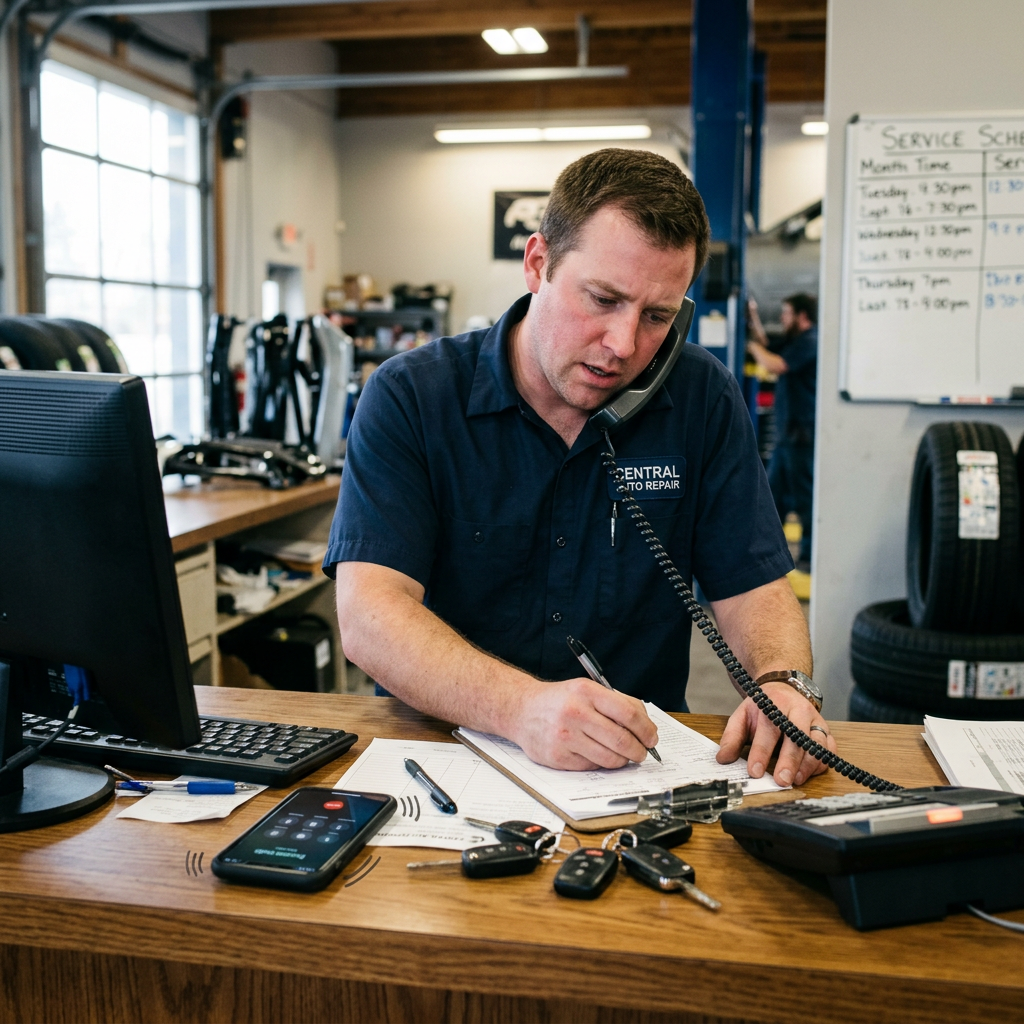
The phone is the single biggest interrupter at the front counter. Every ring pulls your service writer out of whatever they’re doing, whether that’s building an estimate, explaining a repair to a customer, or coordinating with a tech. A phone answering service that handles inbound calls during peak hours can change the feel of your entire shop. Calls get answered. Appointments get booked. Your service writer stays focused on the people in front of them.
An AI receptionist trained on your shop can pick up every call, 24/7. It answers questions about your hours, your services, and your availability. It books appointments directly into your schedule. And it does it at 10 PM on a Saturday when someone’s check engine light just came on and they’re looking for a shop that’s open Monday morning. That call used to go to voicemail. Now it goes to your calendar. If you want to hear what this sounds like for an auto shop, check out how it works for automotive businesses.
Next, look at your follow-up process. How are you letting customers know their car is ready? How are you sending estimates for approval? If the answer is “my service writer calls them,” that’s a stack of phone calls competing with everything else they need to do. Text message updates can handle a huge portion of this. A simple text that says “Your vehicle is ready for pickup” or “We found an additional issue, here’s the updated estimate” keeps the customer informed without pulling your advisor off the counter.
Scheduling software with automated appointment reminders is another easy win. If your service writer is manually calling people to confirm tomorrow’s appointments, that’s 15 to 20 minutes a day spent on something a system could do automatically. Those minutes add up.
Finally, create a priority system for when things get hectic. Your service writer needs to know: when there are three people at the counter and the phone is ringing, what comes first? Without a clear answer, they’re making that decision under stress dozens of times a day. Give them a framework. Phone calls get routed to your AI receptionist. Walk-ins get greeted and checked in. Estimates get built in order. Callbacks happen during scheduled blocks, not whenever there’s a gap. Structure reduces chaos, even when volume stays the same.
Rebuilding Customer Trust Through Better Communication
Most drivers carry at least some skepticism about auto repair shops. You’ve seen it. The customer who asks too many questions about a straightforward repair. The one who wants to see the old part. The one who gets a second opinion on a quote you know was fair. That skepticism doesn’t come from your shop. It comes from every bad experience they’ve ever had, and it means you have to earn trust actively, not just assume it.
Trust isn’t built by doing good repairs. Trust is built by communicating clearly before, during, and after the repair. The shop that calls with an update, even when the update is “no news yet, still waiting on the part,” earns more trust than the shop that does perfect work but goes silent for three days.
The problem is that consistent communication takes time your service writer doesn’t have. That’s why systems matter. Automated text updates, a phone service that makes sure no call goes unanswered, and scheduled follow-up blocks all create consistency without adding hours to your advisor’s day.
Think about your own experience as a customer somewhere. The businesses you trust most aren’t necessarily the ones that do the best work. They’re the ones that keep you informed. The ones where you never have to wonder what’s going on. Your customers feel the same way about your shop.
One Change This Week
Your service writer shouldn’t be your shop’s bottleneck. They’re probably your most valuable front-of-house employee, and right now they’re spending half their day on tasks that don’t need their expertise. Phone calls that could be handled by an AI receptionist. Reminders that could be automated. Follow-ups that could be a text message.
Pick one thing. If your shop is missing calls during peak hours, start there. Try an AI receptionist that answers on the first ring, books appointments, and gives your service writer room to actually do their job. If follow-up is the weak spot, set up a text update system this week.
You don’t have to fix everything at once. But the shops that figure this out are the ones that capture the customers leaving dealerships right now. The ones that don’t will keep watching their service writer drown while the phone rings in the background.
Want to hear how an AI receptionist handles calls for auto shops? Call ours at +1 587-742-8858 and test it yourself. Or book a quick call and we’ll show you how it works for your shop specifically.