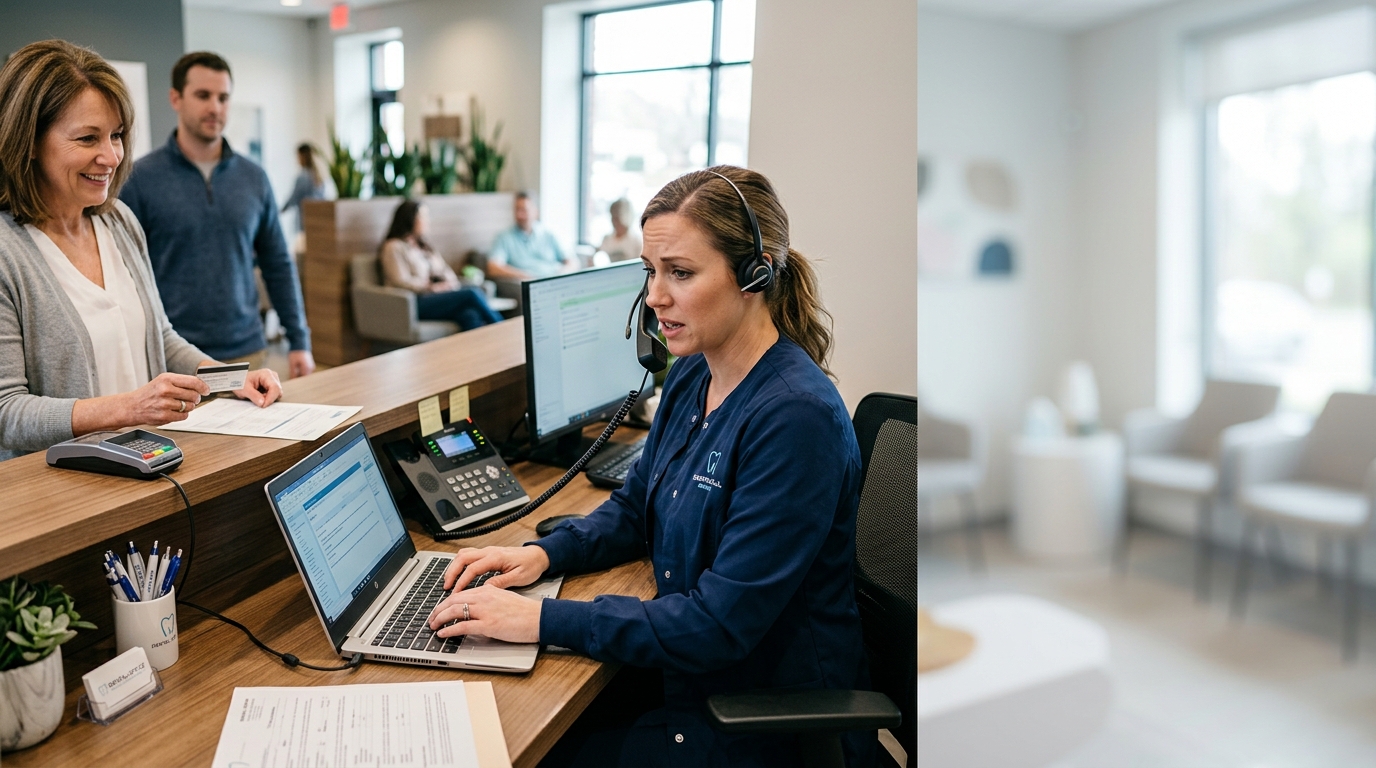
It’s 8:15 AM and your front desk is already underwater. The phone is ringing. Three patients are standing at the counter waiting to check in. Your receptionist is trying to pull up a patient record, confirm an insurance detail, and answer the line all at once. She puts the caller on hold. The caller hangs up. Another call comes in behind it. That one goes to voicemail. By the time the morning rush clears, you’ve missed two calls from people who found your practice on Google, were ready to book, and will now call the next dentist on the list instead.
This isn’t a bad day. For most dental offices, this is just a Monday. The problem with dental office phone calls isn’t that your team doesn’t care. It’s that they’re being asked to do two jobs at once, and both jobs require their full attention.
The good news: this is fixable. But first, you need to understand what’s actually happening with your phones and why it’s costing you more than you think.
Why Dental Offices Struggle with Missed Calls
Your front desk team isn’t ignoring the phone. They’re buried. They’re checking patients in, verifying insurance, processing payments, answering questions from people standing right in front of them. The phone rings in the middle of all that, and something has to give.
Usually, it’s the phone.
According to dental practice management expert Beverly Wilburn, she reviewed one practice’s call reports and found that 29% of their calls went to voicemail in a single day. Not because the staff was lazy. Because there simply weren’t enough people to cover the phones while handling everything else.
That lines up with what dental offices report across the board. Many practices that track missed calls cite staffing shortages as the main reason. Not a lack of effort, just a lack of hands. Your front desk person isn’t failing. They’re one person trying to do the work of two or three.
Dental consultant Malika Azargoon points to the same issue: insufficient manpower is one of the top problems in practices today. When calls go unanswered, it’s almost always because staff are tied up with check-ins, billing, or other in-person duties. Not because they don’t care.
What Unanswered Dental Office Phone Calls Actually Cost You
A missed call might feel like a small thing in the moment. The phone rang, nobody got to it, life goes on. But each of those calls has a face behind it. Someone with a toothache, a parent looking for a pediatric dentist, a new resident searching for a practice close to home. And when they don’t reach you, they don’t wait.
Research consistently shows that new patients often make their decision about a dental practice based on their first phone interaction. That means the phone call isn’t just a step in the process. For most new patients, it is the decision point. If nobody picks up, you never get the chance to impress them with your chair-side manner or your five-star Google reviews.
It gets worse. CallRail surveyed a thousand consumers in 2025 and found only 42% leave a voicemail when a business doesn’t pick up. They’ll just move on. Many won’t leave a voicemail at all, so you won’t even know they called unless you’re checking your call logs, which most practices don’t do regularly.
This is the same pattern we see across industries. The real cost of a missed call is almost always higher than business owners expect, because it’s not just one lost transaction. It’s a patient who would have come back twice a year for cleanings, referred their spouse, and brought their kids in. One missed call can represent years of lost revenue.
Peak Hours Are Breaking Your Front Desk
The calls don’t come in evenly throughout the day. They pile up at the worst possible times. Early morning, when patients are calling before work to book or confirm. Lunch hour, when people finally have a free minute to make that call they’ve been putting off. Late afternoon, when the day’s schedule is winding down but the phones are still going.
These are exactly the times when your front desk is busiest with patients who are physically in the office. Check-ins at 8 AM. Payment processing and checkout around lunch. End-of-day scheduling for follow-ups. Your receptionist can’t pause a conversation with the patient standing in front of them to take a phone call. And they shouldn’t have to.
But here’s what happens when dental office phone calls go unanswered during those peaks: patients placed on hold, even briefly, are significantly more likely to hang up. That’s barely enough time to finish a sentence with the person at the counter, let alone put them on a proper hold.
The result is predictable. Front desk staff start to see the ringing phone as an interruption rather than an opportunity. They’re not wrong, from their perspective. They’re already stretched thin, and every call pulls them away from the patient right in front of them. But each of those “interruptions” might be a new patient worth thousands of dollars over their lifetime with your practice.
This is the same dynamic that plays out in chiropractic offices dealing with long hold times and in auto shops where techs can’t get to the phone. When the people doing the work are also expected to answer the phones, both jobs suffer.

How to Stop Losing Patients to Missed Dental Office Phone Calls
You’ve got a few options, and they’re not mutually exclusive. The right fix depends on your practice size, your budget, and how many calls you’re actually missing. (If you don’t know that number, that’s the first thing to figure out.)
Audit your call logs. Beverly Wilburn recommends reviewing your phone reports weekly to spot patterns. Which hours are you missing the most calls? Which days? You can’t fix what you can’t see. Most modern phone systems track this automatically. If yours doesn’t, that’s a problem worth solving on its own.
Set up call forwarding for peak hours. If you know your worst window is 8 to 9:30 AM, route overflow calls to a backup line during that time. This could be a second staff member, an answering service, or an AI receptionist that picks up when your team can’t. The point is that no call should ring out to voicemail during your busiest hours.
Give your receptionist quick scripts. A lot of time gets wasted on calls because staff don’t have a fast path to the right answer. A simple scheduling script (“I can get you in Thursday at 2 or Friday at 10, which works better?”) cuts call time significantly. Training your team to offer alternatives instead of saying “we don’t have anything available” keeps potential patients on the line instead of sending them to your competitor.
Consider a virtual receptionist for overflow. An AI receptionist picks up on the first ring when your receptionist is checking in a patient. Not as a replacement for your front desk, but as backup. It answers questions about your hours, your services, your insurance acceptance. It books appointments directly into your scheduling system. And it does this 24/7, including evenings and weekends when your office is closed but people are still searching for a dentist.
The patient gets their question answered and an appointment booked. That’s what matters.
What This Looks Like in Practice
One dental practice tackled their missed call problem by starting simple: they set up a basic phone tree to triage incoming calls. Patients calling to confirm an existing appointment got routed to an automated system. New patient inquiries went straight to the front desk. Emergency calls got flagged. The result was a 40% reduction in missed calls, just from sorting the traffic so the front desk wasn’t trying to handle everything in one queue.
That’s a good first step. But it still relies on a human picking up the phone for the calls that matter most, the new patient calls. And if that human is in the middle of checking someone in, you’re back to the same problem.
Cloud-based phone and scheduling systems help too. When your receptionist can pull up a patient record in seconds instead of toggling between three different programs, calls get shorter and less stressful. Faster calls mean fewer calls stacking up in the queue.
The fix is simple: stop relying on one person to be in two places at once. Your front desk should focus on the patients in the office. Your phones need to be covered by something that doesn’t get overwhelmed, doesn’t put people on hold, and doesn’t let calls ring to voicemail.
That’s what an AI receptionist does. It’s trained on your practice. It knows your hours, your providers, your services, your insurance list. It answers the way you’d want your best receptionist to answer, on a good day, when they’re not juggling five things at once. And it does it every single time, whether it’s 9 AM on a Monday or 10 PM on a Saturday when someone chips a tooth at dinner.
Your Front Desk Deserves Backup
The dental offices losing the most patients to missed calls aren’t the ones with bad teams. They’re the ones asking good teams to do the impossible. You can’t answer the phone and check in a patient at the same time. You can’t be fully present with the person in front of you while worrying about the call you’re missing. Something always gives, and your competitor is happy to pick up what you drop.
The fix isn’t another person in a seat. It’s covering the hours when nobody is at the front desk. It’s giving your current team the backup they need so every call gets answered and every patient in the office gets the attention they deserve.
If you want to hear what this sounds like for a dental practice, call our AI receptionist at +1 587-742-8858 and try it yourself. Or book a quick call with our team and we’ll walk you through how it works for dental offices specifically. No pressure, no pitch deck. Just a conversation about your phones and whether we can help.