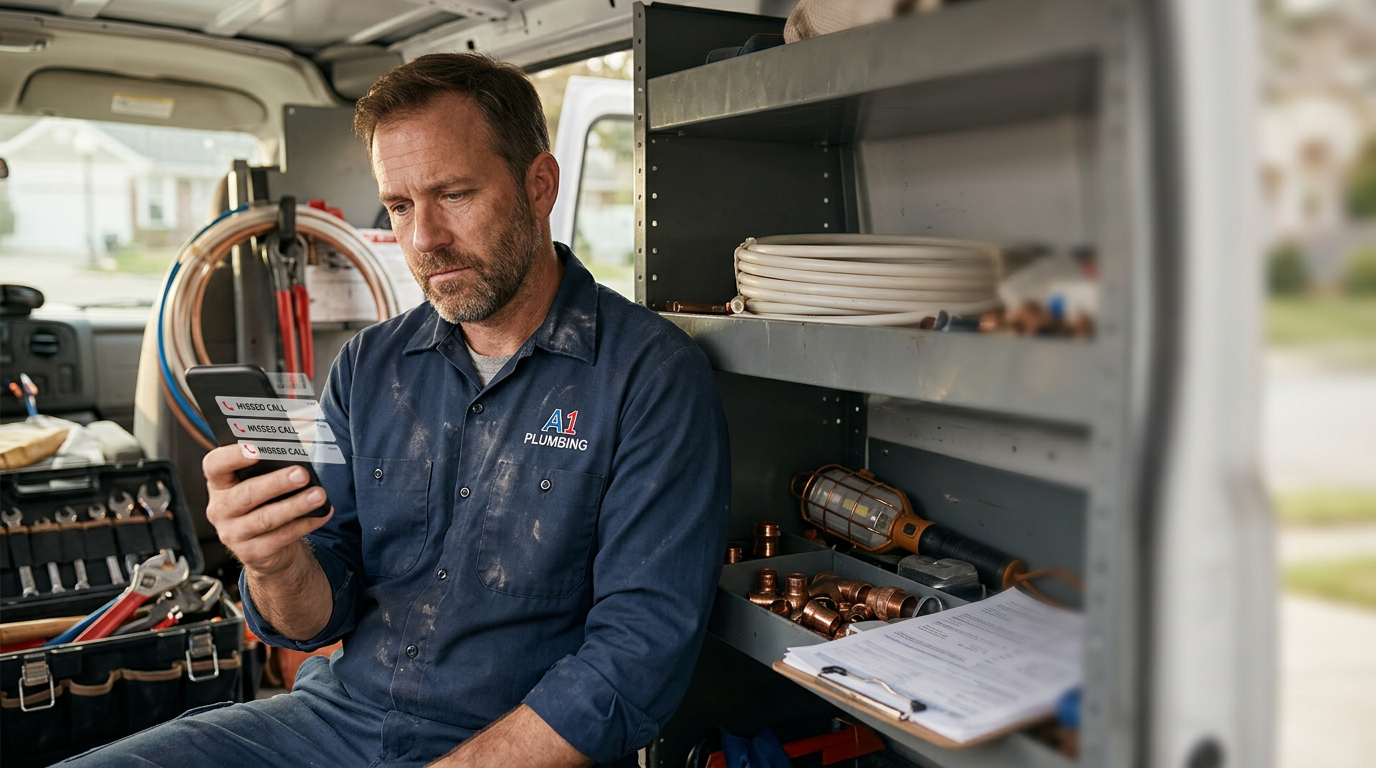
It’s 9:30 AM on a Tuesday. Your crew is spread across three jobs. The office phone rings, but nobody’s there to pick it up. By the time you check voicemail at lunch, the caller with a leaking water heater has already booked with a competitor who answered on the first ring. You’ll never know their name. You’ll never get that job. And this is how missed calls quietly drain real revenue from plumbing businesses every single week.
The worst part? Most plumbing business owners don’t realize how often it happens. You can’t miss what you never knew was there. But the numbers tell a clear story, and it’s not a comfortable one.
Plumbing Businesses Miss More Calls Than They Think
According to a 2024 Vocaly AI report, plumbing businesses miss roughly 28% of calls during business hours. Other studies put the number even higher. A 2023 HeyRosie analysis found that small and mid-sized service businesses miss up to 62% of inbound calls. The exact rate depends on your business size, call volume, and staffing, but the range is consistent: somewhere between a quarter and more than half of your calls go unanswered.
If your shop takes around 600 inbound calls a month, which is typical for an established operation, even the low end of that range means well over 100 calls that nobody answered. Real people, with real plumbing problems, calling your business and getting nothing.
Now think about what happens next. According to a 2022 Phone2.io analysis, the majority of callers who can’t reach a business won’t try again. They’re not leaving voicemails. They’re not calling back tomorrow. They’re scrolling to the next plumber in Google and hitting dial.
The average plumbing service call typically ranges from $250 to $400, depending on your market and the type of work. Even at a conservative conversion rate on answered calls, every missed call represents real money walking out the door. The kind of money that pays for a new van, covers payroll for a month, or funds the marketing budget you’ve been putting off.
The annual cost of missed calls varies widely depending on your call volume and conversion rates, but most plumbing operations find it’s a significant number worth measuring. Even if you’re on the low end, it’s almost certainly more than you’d guess.
Emergency Calls Disappear Fastest and Cost the Most
Emergency plumbing calls are where missed calls get especially expensive. A burst pipe at 10 PM on a Saturday isn’t something a homeowner is going to “circle back on” Monday morning. They need someone now.
According to a 2024 Vocaly AI report, plumbing businesses often receive 8 to 12 after-hours emergency calls per week. That’s potentially over 500 calls a year coming in when your office is closed. And according to the same source, the vast majority of those after-hours callers won’t leave a voicemail. They’ll hang up and call the next plumber on the list.
Emergency jobs are also your highest-margin work. Urgency pricing pushes the average emergency service call well above your standard rates, with some jobs running over $2,000. When a homeowner has water pouring through their ceiling, they’re not shopping for the cheapest option. They’re calling whoever picks up.
If even half of those after-hours callers would have converted into paying jobs, the annual revenue lost from after-hours misses alone adds up fast. Contractors who lack after-hours coverage consistently report losing significant revenue from emergency calls they never even knew about. That’s not your total missed call cost. That’s just the nights and weekends.
The Hidden Domino Effect of Missed Calls
A missed call doesn’t just cost you one job. It sets off a chain reaction that compounds over time.
First, there’s the immediate loss. According to a 2024 Callbird AI report, the average plumbing business takes over four hours to return a missed call. By that point, most of those callers have already booked with a competitor. The window is measured in minutes, not hours.
Then there’s the reputation damage. A homeowner who can’t reach you when they have an emergency isn’t going to feel neutral about your business. They’re frustrated. Some of them will leave a negative review. Others will simply never consider you again, and they’ll tell their neighbors the same. One bad experience with an unanswered phone can ripple through a neighborhood for years.
And then there’s the repeat business you’ll never see. Emergency plumbing customers are some of the most loyal clients you can earn. The plumber who showed up at midnight when their basement was flooding? That’s who they call for every future job. That’s who they recommend to their brother-in-law. When you miss that first emergency call, you’re not just losing one job. You’re losing a customer who might have been worth thousands of dollars over the next decade.
This compounding effect is why contractors across every trade lose repeat customers to competitors who answer the phone. The calls you miss today don’t just disappear. They actively build your competitor’s business instead of yours.
Real-World Examples from Plumbing Companies Like Yours
These aren’t hypothetical. These are the kinds of jobs plumbing businesses lose every week to unanswered phones.
The burst pipe that called five shops. Monday at 2:15 PM. A homeowner discovers water pouring from a pipe in their wall. They call their regular plumber. No answer. They call four more. The third one picks up and has a tech on site within 90 minutes. The job: $2,400. The plumber who would have gotten that call was under a sink on another job, phone in the van. He never knew it happened.
The water heater that couldn’t wait until morning. Tuesday at 8 PM. A family’s water heater fails. No hot water, and they’ve got a houseful of guests arriving the next day. They call their usual plumber and get voicemail. They Google “24/7 plumber near me” and book with the first company that answers. Job value: $1,800 for a full water heater replacement. The original plumber sees the missed call Wednesday morning and calls back. Too late. The new unit is already installed.
The whole-home repipe that went to whoever answered first. A homeowner dealing with recurring leaks in an older home decides it’s time to repipe the whole house. They call five plumbing companies on a Saturday morning to get quotes. The two that answer get site visits scheduled. The three that don’t answer, don’t. The job is worth $9,000. It goes to one of the two who picked up the phone.
In every one of these scenarios, the plumber who lost the job was perfectly capable of doing the work. They had the skills, the equipment, the availability. They just didn’t answer the phone.
Three Steps to Stop Losing Revenue from Missed Calls
You don’t need to overhaul your entire business to fix this. But you do need to be honest about how many calls you’re actually missing, and then do something about it.
Step 1: Set up call forwarding to mobile devices when office lines are busy. This is the bare minimum. If your office phone rings four times and goes to voicemail, you’ve already lost the caller. Forwarding to a cell phone at least gives you a shot. The problem is that you’re still limited to one person answering at a time, and that person is usually busy doing plumbing work. It helps, but it doesn’t solve the core issue.
Step 2: Add after-hours answering coverage, specifically for emergency calls. Your competitors who advertise 24/7 availability aren’t necessarily working 24/7. They just have someone answering the phone 24/7. That’s the difference between getting the midnight burst pipe call and losing it. Whether that’s a traditional answering service or an AI receptionist that’s trained on your plumbing business, the point is the same: someone needs to pick up when you can’t.
Step 3: Track your call response metrics every week. Most plumbing business owners dramatically underestimate their missed call rate. Pull the data from your phone system. Look at how many calls came in, how many were answered, and how long it took to return the ones that weren’t. You’ll probably be surprised. Until you measure it, you’re guessing. And guessing is how you end up losing real revenue without realizing it.
The Phone Is Still Your Most Important Sales Tool
Plumbing is a phone-first business. Homeowners with a clogged drain or a leaking pipe aren’t filling out contact forms. They’re not sending emails. They’re calling. And they’re calling right now, because the problem is happening right now.
Every call that goes unanswered is a customer choosing someone else. Not because you’re not good at what you do. Not because your prices are too high. Just because you didn’t pick up.
An AI receptionist answers every call on the first ring, 24/7. It books appointments, captures caller information, and handles the conversation the way you would if you weren’t elbow-deep in a sewer line. Your callers get a real conversation, not a voicemail box. And you get the lead instead of your competitor.
If you want to hear what that sounds like for a plumbing business, call ours and test it yourself: +1 587-742-8858. It takes about 30 seconds to understand why your callers would rather talk to it than leave a voicemail. And if you want to see how many calls your shop is actually missing, book a quick call and we’ll walk through the numbers with you.
The calls are already coming in. The only question is who’s answering them.